Pini Kay vs RUF: Which Briquette Format to Choose for B2B Supply in 2026
What Pini Kay and RUF Are: A Quick Breakdown of the Differences
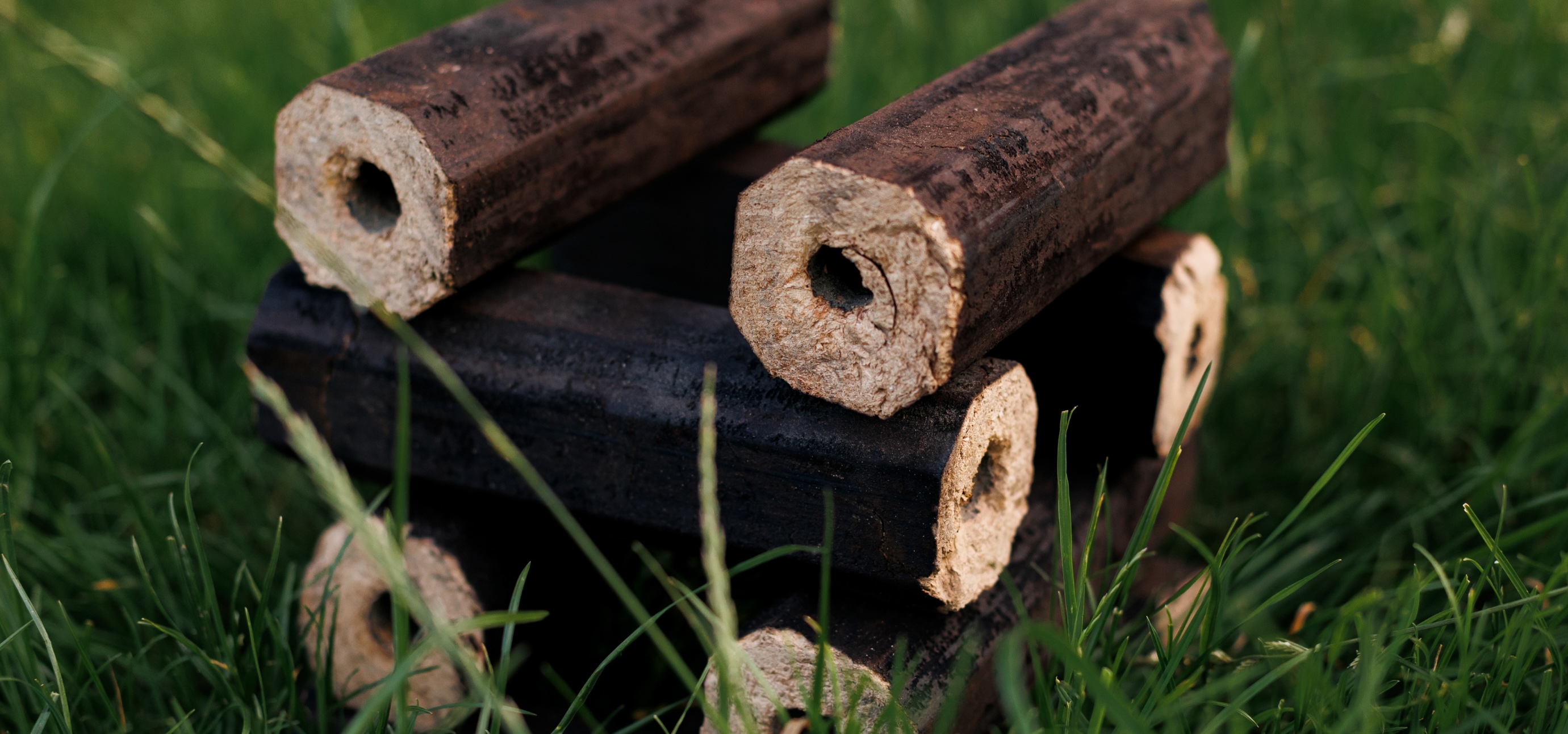
Pini Kay has a cylindrical shape with a central hole and is traditionally produced on a screw press under high pressure and temperature (though in practice some production lines use hydraulic presses for similar formats as well — there's no strict rule here). Density typically exceeds 1,000–1,100 kg/m³, reflecting a high degree of compression. Calorific value runs roughly 17–19 MJ/kg — a typical range for dry sawdust briquettes that depends on wood species, residual moisture, and compression level, so exact figures should be checked against the supplier's technical data sheet. Moisture content is usually up to 8–10%, and ash content is low, around 1%, though this can vary depending on bark content or other impurities in the raw material. Because of its round shape, Pini Kay stacks on a pallet with natural gaps between briquettes. It's typically packaged in shrink film in blocks. Typical use: boilers, stoves, and industrial heat generators.
RUF has a rectangular, brick-like shape and is traditionally produced on a hydraulic press. Density is around 900–1,000 kg/m³ (also depending on pressing technology and raw material). Calorific value falls in the same approximate 17–19 MJ/kg range, moisture up to 8–10%, and low ash content, with the same caveats regarding raw material. Thanks to its flat faces, RUF stacks on a pallet significantly more densely than Pini Kay. It's packaged in shrink film or cardboard boxes. Typical use: fireplaces, stoves, and the retail B2C segment.
On basic lab metrics — calorific value, moisture, ash content — both formats are close to each other within the typical ranges for quality briquettes under the EN ISO 17225-3 standard. The real difference between them shows up not in these numbers, but in shape, packing density, and compatibility with specific equipment types.
Calorific Value and Combustion Efficiency
Both briquette types have similar energy characteristics thanks to identical raw material — dry softwood or hardwood sawdust with no additives. The difference shows up less in calorific value per kilogram and more in combustion behavior depending on equipment type — and burn intensity always also depends on air supply mode, briquette size, and firebox design, so the following should be read as a general tendency rather than an absolute rule:
- Automated boilers and industrial heat generators. Thanks to its central hole, Pini Kay allows better airflow through the briquette, which in many cases gives a more even and predictable heat output profile — especially valuable where stable heat load is critical for automation to function properly.
- Classic fireplaces and stoves. Due to its denser, solid structure without a hole, RUF can burn more intensely at the initial stage under certain conditions — which can be an advantage where visual flame effect matters, typical of the retail B2C segment.
For industrial B2B clients with automated fuel-feed systems, Pini Kay is more often chosen specifically for its predictability, not for objectively higher calorific value.
Logistics and Storage: Where RUF Wins
This is a key factor for wholesale buyers and distributors. RUF's rectangular shape allows:
- denser pallet stacking with no empty space between briquettes;
- more efficient use of container or truck volume on long-haul transport (including sea shipments to Western European ports);
- simpler warehouse stacking without special pallets.
Because of its cylindrical shape, Pini Kay leaves natural gaps between briquettes when stacked, meaning a lower loading density for the same transport volume. For distributors optimizing logistics cost per tonne, this is a meaningful difference — especially on international deliveries, where freight makes up a significant share of the final price.
A typical pallet of briquettes (packaged in shrink film) weighs roughly 800–1,200 kg depending on packaging format and manufacturer — exact figures are worth confirming with your specific supplier, since packaging standards vary. Thanks to denser stacking, a container or truck can fit noticeably more pallets of RUF than of Pini Kay for the same volume — in practice this can mean a difference of several percentage points in logistics cost per tonne of cargo. For an exact calculation tailored to your route and volume, it's worth asking your supplier for specific fill-rate figures.
If your supply model involves long transport legs (for example, from Ukraine to Germany or the Netherlands), the difference in loading density between RUF and Pini Kay can affect the logistics cost per tonne — by how much depends on the specific transport and packaging type, so we always recommend calculating this individually with your supplier.
Warehouse Storage
Both briquette types require dry, ventilated storage space and protection from direct moisture contact. However:
- RUF, thanks to its flat surfaces, more easily forms stable, tall stacks without risk of collapse;
- Pini Kay requires somewhat more careful stacking due to its cylindrical shape, especially with manual loading without pallet packaging.
Price Structure and B2B Margins
Production cost for both briquette types is similar, since the raw material and pressing technology are close in capital cost. Differences in the final price for the buyer are more often tied not to the briquette itself, but to:
- Logistics efficiency — as shown above, RUF often delivers lower transport cost per tonne thanks to better loading density.
- Target market — RUF has historically been more strongly represented in Western Europe's retail B2C segment (fireplace culture, the "classic firewood brick" aesthetic), while Pini Kay is more often chosen by industrial and utility consumers.
- Contract type — for long-term B2B contracts with industrial buyers (boiler houses, heat generators), Pini Kay is often the standard expected format, which affects demand and, accordingly, the supplier's pricing position.
EUDR and Raw Material Origin Transparency: Equally Important for Both Formats
Regardless of which briquette format you choose, the core requirements of the EU Deforestation Regulation (EUDR) take effect on December 30, 2026 for large and medium operators and traders (for small and micro enterprises — from June 30, 2027). Scope of application depends not only on company size, but also on its role in the supply chain — an operator placing goods on the EU market for the first time versus a trader reselling them further; due diligence requirements differ between these roles. Wood and wood-derived products, including fuel briquettes, are among the seven regulated commodity groups.
In practice, this means a B2B buyer should proactively ask suppliers for:
- geolocation data for the plots where the raw material was harvested;
- confirmation that the wood was harvested legally under the laws of the country of origin;
- ENplus and/or FSC certification, confirming traceability across the entire supply chain.
This means that for B2B buyers in the EU, the choice-of-supplier criterion increasingly depends less on briquette shape (Pini Kay or RUF) and increasingly more on the supplier's ability to provide this documentation. In this context, ENplus and FSC certifications become not just a marketing advantage, but a practical tool for preparing for EUDR due diligence requirements.
What to Choose: A Short Practical Guide
Choose RUF if:
- you're optimizing long-distance international logistics costs;
- your end customer is the retail B2C segment with classic fireplaces;
- pallet and container loading density matters.
Choose Pini Kay if:
- your end client is an industrial or utility facility with an automated solid-fuel boiler;
- the priority is stable, predictable heat output;
- your sales market is less sensitive to the logistics component of price (for example, local supply).
In practice, many European distributors work with both formats in parallel, splitting them across different customer segments — this covers both industrial and retail demand without having to pick a single format.
Pini Kay and RUF aren't competing formats — they're complementary solid biofuel formats, each with its own niche in the supply chain. For a B2B buyer, the decision should be based not on general briquette characteristics (which are nearly identical), but on the specific logistics model, end equipment type, and target market requirements. As EUDR deadlines approach, raw material origin transparency and ENplus/FSC certification become an equally important supplier-selection criterion — regardless of which briquette format is chosen.
Inflame supplies ENplus- and FSC-certified Pini Kay and RUF briquettes to B2B and B2C clients across Europe. Get in touch — we'll prepare a free logistics calculation and format comparison tailored to your route and delivery volume.